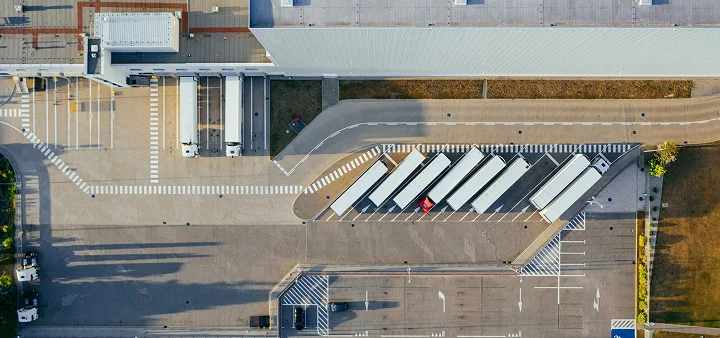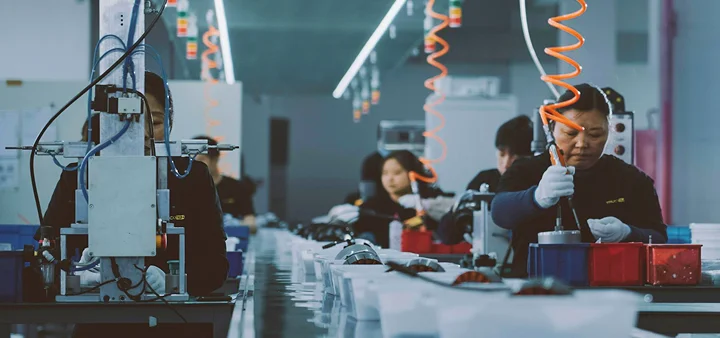
Jerry Frisch, President of Wasatch Container, recently led AICC members on a virtual plant tour of his 35,000-square-foot box plant, along with his crate and foam divisions, all located in within a few miles of each other in Salt Lake City, Utah. The event was the second of the AICC-sponsored Virtual Plant Tour Series.
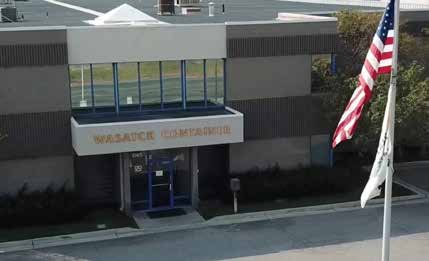
Wasatch Container’s 35,000-square-foot box plant and its crate and foam
Wasatch Container prides itself on being a diverse packaging company, specializing in custom corrugated packaging, stock boxes, foam and crates. The diversification and success of the company has evolved over time since the plant was built.
Frisch began the tour explaining that he got his start in packaging when he graduated with his degree in Packaging Engineering and then went to work for a folding carton plant in Utah. He left the folding carton plant and decided to start Wasatch Container, a greenfield facility, in 1995.
A few years after the plant was built, Wasatch acquired a foam fabrication company, which complemented its existing corrugated business well. Several years later, a customer approached Frisch about getting into the wood crate business, which seemed like a good fit considering the crossover between foam and crates. Frisch then purchased a 67,000-square-foot facility nearby to house the foam and crate divisions. In 2019, Wasatch acquired a local stock box company, Box Essentials, which is managed offsite by Lauren Frisch.
Most recently, Wasatch installed a BW Papersystems MiniPro Flexo Folder Gluer that is able to print three colors outside and one color inside, all in a single pass. The inside/outside printing capability has expanded Wasatch’s customer base, resulting in its eCommerce business growing significantly. “The MiniPro is a fabulous machine for eCommerce,” commented Frisch about the first machine of its kind in the region.
“The fact that we don’t have to open and close the machine to switch out print plates and ink is ideal for set-up times,” said Jason, the machine operator. “In my opinion, the MiniPro is one of the best printing machines I’ve ever worked on, as far as how it prints and the quality.”
The designers’ goal at Wasatch is to provide customers with an attractive, unique and custom box that adds value to their product and provides the end-user with an enjoyable “unboxing experience.” The printing capabilities of the MiniPro, along with Arden Impact CAD software and a Zund cutting table, allow them to do just that. In order to keep up with the MiniPro machine speed of 22,000 boxes per hour, Wasatch Container installed a Systec Load Former with the optional high-speed application, along with other Systec material handling devices, including a pallet inserter, bundle conveyor, unitizer controls and Stable Stack conveyor for the Mosca unitizer infeed and outfeed.
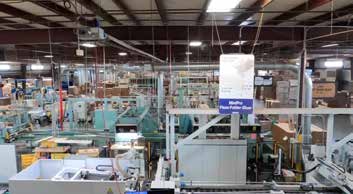
In 2008, Wasatch Container purchased a 3-color 50-inch Flexo Folder Gluer. Frisch explained that this is the workhorse of their plant and has contributed to the growth of their business.
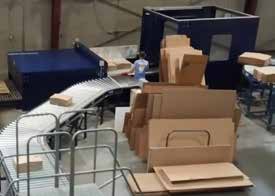
Also, in the plant is a 2-color 66-inch by 110-inch Ward Rotary Die Cutter that prints. Although this requires two passes for 2-sided printing, many of the award-winning boxes that are proudly displayed in the lobby, have been printed on the Ward machine. “Between our talented people and this machine, we’ve been able to do some outstanding printing,” said Frisch.
Wasatch partnered with BCM Inks for an extensive ink kitchen, allowing Wasatch to custom match inks and their customers’ corporate colors. Along with BCM Inks, it has partnered with J&L on their 80-inch gluer, which allows for straight line gluing, four corner trays and auto-bottoms.
In the packed, 35,000-square-foot facility a visitor will also find a Bobst SPO 160 Die Cutter. “We purchased this primarily for high-quality die cutting as well as matrix scoring and die cutting,” said Frisch.
Crate & Foam Divisions
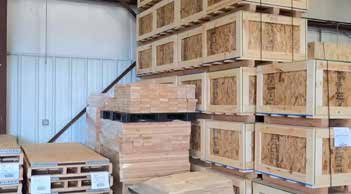
Frisch concluded the tour at the Wasatch Container Crate and Foam facility. All of the wooden crates are produced at this location, as well as a 40,000-square foot area that houses the Foam Division. Here, Frisch highlights the Atom Flash cut machine, used for dieless die cutting, a water jet die cutter and self-feeding die cutter for high-volume work. Much of their crate and foam business comes from the company’s aerospace and military customers. Frisch notes that although the foam business isn’t growing much due to the cost of materials, their case business is very niche and has a lot of room for potential growth.

Growth And Future Investments
Frisch explained that it’s the specialty and diverse packaging that has aided much of the company’s growth. The eCommerce business has grown largely due to buying habits during the pandemic and the printing capabilities of the MiniPro. When asked who the customers are that typically want inside printing, Frisch said, “Many of these customers want to increase their brand recognition by using the inside print as a branding tool. These are customers who are looking to give the end user a memorable and long-lasting impression when they open the box.”
Wasatch Container has grown from a basic box plant into a diverse packaging company with niche markets, producing everything from foam (with or without cases), crates, corrugated boxes, and custom print packaging, including eCommerce.
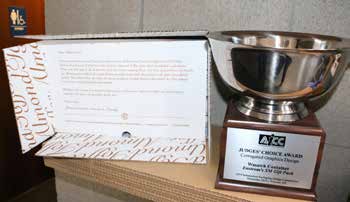
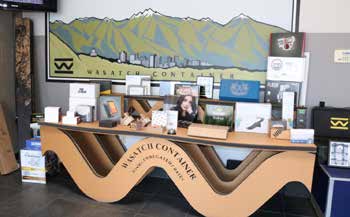
With 78 employees, two locations, an additional stock box business, Jerry Frisch has built an impressive reputation in the Utah valley and the surrounding areas. Wasatch Container serves a variety of markets, including: consumer products, aerospace, military, pharmaceuticals, medical devices and eCommerce. The company has also won numerous awards for its foam inserts, crates and custom printed boxes, including the AICC Judges Choice Award that sits upon a floating shelf made of corrugated sheets, in their lobby.
Like many in the corrugated industry, Wasatch felt the hit of the coronavirus in March and April. “Covid has been the most challenging and difficult thing to manage because of the fear,” said Frisch. Along with the pandemic, Salt Lake City experienced a 5.8 magnitude earthquake in mid-March, followed by 90 mph winds that wreaked havoc in the city. Even with all of those challenges, the business has bounced back, resulting in year-over-year sales that are up significantly.

Frisch’s dream, however, hasn’t fully come to fruition yet. He announced that he plans to continue investing in his business and soon hopes to finalize plans to add an additional 90,000-square-feet of plant space to the existing facility. The foam and crate division will remain at its current location, as will Box Essentials.
When asked if Frisch plans to get into digital printing, he stated that Wasatch will likely continue outsourcing its digital print business to AICC partners. They are currently studying options for printing on a rotary die cutter, as the plant expansion will likely include the purchase of a new machine and the material handling equipment to go with it.
Frisch was also asked about succession planning, to which he explained that it is his intent to transition the business to his children, Ryan and Lauren Frisch.
Jim Davis, retired owner of DeLine Box, closed the virtual tour by commending Jerry Frisch on his accomplishments at Wasatch saying, “I’ve known you since before you could spell the word ‘box’. You’ve come a long way and if there’s anyone that’s an entrepreneur, it’s you. You’ve done a fabulous job out there and its very impressive.”
AICC will continue its Virtual Plant Tour series on February 17th at 2:00 p.m., when it will showcase The BoxMaker in Kent, Washington. The full schedule for future plant tours can be found at www.aiccbox.org/virtualtours.

AICC’s Virtual Plant Tours have been pre-recorded and will be showcased during a live Zoom event. Employees from of the company being toured will be available to answer questions following the tour, along with AICC supplier member companies who are represented in the host plant. The event concludes with 15-20 minutes of breakout rooms for those that wish for further insight from the supplier members and to network.