
Uncategorized

Category Listing Page

Converter Outlook 2021, Part 1: Demand Continues In Pandemic

As is our annual tradition, Board Converting News solicits a representative sample of the continent’s independent converters for a glimpse into their minds as they embark on another year in the ever-dynamic corrugated, folding carton and rigid box making industries. The coronavirus pandemic has affected all facets of life, both globally and here in North America and it’s never been clearer that boxes and packaging absolutely fit the description of an “essential business.” The converters here have shared their business strategies, political views and industry forecasts. They have also raised some questions – and provided some expert analysis – for the year that will be 2021:

ACME CORRUGATED BOX CO.

Hatboro, Pennsylvania: Bob Cohen reports, “As I write this article, we are experiencing an almost surreal box demand surge. The pandemic of 2020 has added a sense of uncertainty to a once predictable way consumers traditionally source and then purchase personal requirements. With retail being out of the question for many consumers, the obvious default position has been the internet. Simply put, the change in buying habits has dramatically impacted the demand for containerboard and for the boxes produced as a by-product.

Converter Outlook 2021, Part 1: Demand Continues In Pandemic
Bob Cohen

“As most converters in the market, we are a main beneficiary in this ever-changing way consumers buy products. The question is, with a coronavirus vaccine now here and a possible return to normalcy on the horizon, what will demand look like in six months? Well for one thing, we know there will be some movement back to retail. We also know that companies like Amazon are intent on reducing their packaging excesses. Most of us will experience the change in demand as consumer buying trends increase the likelihood of other competing materials. We also know that a new administration will focus on climate change. How our industry will factor into that “sustainability” equation is unknown at this point. It would be silly not to think that we will not be affected.

“Our industry has a story to tell about recyclability but is it an old one? The other issue is the rush to find value out of old assets. We see that as the white paper industry is in decline there is a rush to repurpose paper machines both here and in Europe. It has been calculated that by 2023, we will have over 2.2 million tons of new production domestically, adding about 5.9 percent to the total annual mill production. That doesn’t include unannounced conversions and doesn’t take into account capacity creep. In Europe, which is a far more fragmented market, there will be an additional 4.5-5 million tons of both Kraft and recycled capacity (a 17 percent increase) by the end of 2023. Also added will be another one million tons from Klabin in Brazil. So, the question is, how will this capacity be absorbed?

“Sometimes, I think I am watching a train wreck in slow motion. While I was amazed that the market was ripe for a late fourth quarter price increase, I do wonder what the effect rising prices will have in the future. Is the pricing power once held by the four majors eroding even as pricing elevates? It would seem that attaining higher prices is just an invitation for new entrants. We see the result as companies like Pratt, Smurfit Kappa, DS Smith, ND Paper and now SAICA find their way into the domestic market. What are the opportunities they see that domestic producers might not? The question arises as containerboard producers try to position themselves for the future. While everyone spins in their own orbit, do the producers take into account how the market will absorb this new capacity? Where will the integration come from? The independent converter segment is stagnant and sits at about 9-10 percent of the market. How does new capacity find a home? It should be quite interesting. Frankly, I would rather be us than the companies faced with this demand dilemma. “As I mentioned earlier, we enter into the New Year with an overwhelming backlog. We know this can’t last forever, but like all of you reading this, we will ride it out as long as possible. The downside is that we have disappointed clients but probably no more than other raw material suppliers in the supply chain. Paper supply has been tight – some of the tightness manufactured but some caused by uncontrolled circumstances. It didn’t help that Mills were producing in the low 90s as the demand surged dramatically in the fall. In the month of October, we scrambled like most other Independents for supply. Fortunately, we have come out of what I describe as a “once in a decade” demand surge not met by open market capacity.

“I expect the Acme Corrugated Box Co. to continue to find new products, introduce innovative use of flutes and substrates in our efforts to meet market requirements for 2021. We have always viewed ourselves as a “structural” box company. Our approach has always been, “What can we bring to clients that is not readily available” but has demonstrated value? We search globally for those answers and I would say we have done so successfully. We are focused on the performance of the packaging. Does it work? All other criteria seem superfluous to us.

“We, like most independents, compete on competency, innovation and service. To prove value, you must find ways to differentiate yourself in a market that is too often based on ”me too!” value, is established by introducing the best material available, utilizing the best equipment available and then being led by an executive group that truly understands that success is dependent on finding new products and new ways to service our clients. It’s a simple formula but one that has worked extremely well for us.

“As a sign of our overall optimism, we have embarked on a multi-million dollar expansion of our present facility. We do this fully aware that even now there is uncertainty coming out of a worldwide pandemic. Still, the signs we see tell us that we have a duty to meet the future with confidence and forbearance. Our plans have been three years in the making. I do believe that when we complete our expansion our facility will be the envy of other converters. It’s something I am personally very proud to be a part of. Let’s all hope that when this article appears, we are on the road to blotting out this horrific period in our lives. Best wishes to all for a successful 2021!”

BAY CITIES

Pico Rivera, California: Greg Tucker reports, “What’s to come in our next world at retail? We know that retail has been shuttered during the pandemic and e-commerce has grown leap years inside of a few months. Retail shifted to e-commerce, order on-line pick up at store, groceries were delivered by delivery services and everything shifted into a different world of buying goods and services.

Converter Outlook 2021, Part 1: Demand Continues In Pandemic
Greg Tucker

“Travel stopped, airlines were decimated and things like jewelry, apparel and accessories (except masks) were not the place to be invested in. Restaurants were shut down and opened up and shut down again. We bought more toilet paper, disinfectant and paper towels than anyone could ever imagine. We bought more vitamins and immunity solutions than ever before. All of the cold and flu remedies flew off the shelves. The auto industry stopped, and the used car market exploded. The strangest things happened: We learned how to cook, we learned how to read and play instruments, we learned how to work out at home, and the hardest thing of all is that we had kids to care for instead of sending them off to school. Moms took the brunt of this while working at home, cooking, cleaning and teaching their children. Many moms will never return to work. All of this changed the retail market.

Converter Outlook 2021, Part 1: Demand Continues In Pandemic

“So, what’s next for 2021? E-commerce will roar on for the next six months. The pandemic will filter out and we will crawl out from underneath the rocks and come into the light of a new and different world. I believe we will take our streets back from the Amazon, UPS and FedEx delivery employees who have cluttered up our doorsteps with boxes of stuff. One cannot even drive down my street because of all the deliveries being made. And who are those imposter-like delivery people lurking around the neighborhood stealing things off our doorsteps? This too will change as we come out and begin a new normal.

“David Calhoun, the CEO of Boeing, and Michael O’Leary, the CEO of Ryanair, are banking on big changes coming in travel this summer. Ryanair bought 75 737 Max jets. International Airlines Corp. (Air Lingus, British Airways, Iberia) bought 200 737 Max jets for the boom in travel coming soon. Travel will explode this summer. We want to get out!

“People will return to retail in the second half of the year. Restaurants (what’s left of them) will jump in summer. The basic goods we all bought will remain in our pantries, closets and attics for the next two years as we will begin to shop for things we haven’t been able to for a year or more. We will return to a different normal after the first quarter of retail bliss. The “Ugly American” will come crawling out of the rocks into the light after a hard January and February.

“Although some of us will remain in hiding and some of us will refuse the vaccines for whatever reason. Some could see a self-demise. Things like jewelry, cosmetics, anti-aging products and accessories will be hunted down because we will be “going out” again. Outdoor essentials for travel will be sought after. Even cocktail dresses and shoes for style (not slumpy comfort) will be bought. We will again be poised for that “night on the town.”

“Retail will come back with a vengeance in the second half of the year, albeit different, as it will be complemented with scaled-down offerings, but those that are cherished and sought after. We love to shop! We love to eat out and be served! We love to travel! We are so thirsty for that night out of bonding with other humans!

“Theaters, concert halls, ballets, operas, and sports venues will all come back. Culture will be reintroduced into our lives again. So, what does this mean? Online purchases will tail off as we begin to shop. 70 percent of Americans will hit the stores in search of that lost feeling of “the treasure hunt” What will be different is SKU reduction and inventory in stores. We can try things on again and have that item delivered same day or next. Retail employees will actually be helpful as they invite us into a different environment, one mixed with the warm human aspect and a technological self-serve system that helps us understand what we are purchasing We will not be left alone as retail MUST create a new and inviting experience for us to feel safe, secure and welcomed to the new experience.

“Our new shopper will actually have more time to shop. The kids will be back in school and she will no longer be commuting hours to and from work and thus, the retail environment will become a thirst-quenching destination for her. Gone will be the blocky structures of displays and fixtures needed to get us in and out of stores as we foraged for essentials. What will take their place will be soft and inviting shapes of fixturing and displays to help create a “wow” factor in the new retail environment. More use of experiential technology will be needed for those who refuse help from the inviting retail store employees. QR codes will come back in vogue as beacons for information and product demonstration. Vibrant and tasteful signage will be abundant and needed to guide the new shopper though the hunt and assure her that she is safe and secure as she hunts for her fill.

“We will once again get to enjoy the brave new world!”

CAL BOX

Santa Fe, Springs, California: John Widera and Chris Widera report, “Despite changing the way regulated work gets done, liberal leaning California is like a home with a fresh coat of paint but a crumbling foundation. It may look pretty, but underneath the glitz, the structural problems are sobering. Liberty is withering in this serfdom.

Converter Outlook 2021, Part 1: Demand Continues In Pandemic
John Widera

“As in previous tech-led Silicon Valley recoveries, the state of California depended largely on the innovation and start-ups from the interconnected venture capital community. Now the black swan event of COVID-19 has taken the economy hostage, along with manufacturing speeding up its migration out of California. According to the Associated Press, ‘Gripped by the accelerating viral outbreak, the U.S. economy is also under pressure from persistent layoffs, diminished income and nervous consumers, whose spending is needed to drive a recovery from the pandemic.’

Converter Outlook 2021, Part 1: Demand Continues In Pandemic
Chris Widera

“There is a gulf between social justice warriors’ perceptions and spending reality on mega-projects. California can’t pay for things such as hundreds of billions in unfunded government pension obligations; $100-billion on a train; a half-trillion for coronavirus health costs, high public union wages with lifetime benefits, climate change sanctions, etc. Until 2020, businesses were hollering “iceberg straight ahead!” but few listened. Their market sort of felt like Dorothy coming to the crossroad and has yet to meet the scarecrow to tell her which way to go.

“California, with its 40 million people, has four million small businesses that employed more than seven million people. Half are on the precipice of bankruptcy. Business start-ups, the job growth engine that drives change, has come to a screeching halt, like an automatic car transmission that suddenly get thrown in reverse. ‘Hopeful dream surfers’ should consider that the SoCal economy is composed of a hundred of diverse cities with especially high leveraged debts exceeding the recession peaks of 2007 and 2020.

“Public officials insulted by a sense of power would much prefer that citizens burdened with regulations never ask why utility bills and our lagging public education are so expensive or how other states provide better services at a lower cost. Voters prefer law-makers who don’t use bailouts (crony capitalism) like a rigged carnival game.

“President Biden and his liberal elite policy-makers intend to be more connected with the help of higher tax decrees, which are rapidly closing in on a confiscatory level. And like the predatory or exclusionary big tech and media giants, enamored with promises of doing the right thing, we will need a nose test with clothespins to justify the content they don’t like or want to sell us. These firms use algorithms to suppress anything they find mildly disturbing. It seems the business of America is not business. Its monetizing what is in our creative heads such as trends. Hopefully, internet apps provide scrutiny.

“All this buzz isn’t mere chatter, because like a large boulder crashing into a lake, the crisis is akin to waves and will widen. Yet, as the elections are over, there will be a lot more emphasis on socialism, back-to-work and consumer spending in 2021.

“Strategically as an ‘essential’ manufacturer, we continue to invest. A few friendly competitors who have read my books for entrepreneurs are trying to follow our M.O. Some forget Cal Box culture requires shifts in new responses. In the last five months, we have purchased about $7 million dollars of new machinery for our five plants. Why buy now? Simply put, our business plan says we buy advanced technology when competition is dormant and we sell when everybody buys. These new entrepreneurial advantages compared to other offerings is like racing a horse and buggy against our car. If so, can you whip a horse faster to make it go as fast as an automobile? Our balance sheet can handle the investment risk, even though the iron in the fire is of an undetermined temperature, so we expect the best and prepare for the worst.

“Recessions come and recessions go and inevitably things get better. The fed punch bowl will be taken away in due time, too. Whether the shape of recovery is a “V” or a check mark is not the real concern. Federal deficits and total U.S. debt have been a deluded version of reality for some time, but have now reached critical mass. There are no easy answers, only too many seductive quick fixes to the 2021 dilemmas.

American Packaging Corp. To Expand Facility In KS

South Hutchinson, Kansas based American Packaging Corporation, a division of Lawrence Paper Company, recently announced a 100,000-square-foot expansion to its current facility in South Hutchinson.

As privately held independent companies, American Packaging and Lawrence Paper are manufacturers and distributors of corrugated shipping boxes, industrial packaging and point-of-sale displays to businesses throughout the Midwest. Work on the expansion, which will allow space for new equipment, began in December 2020.

“Since merging with Lawrence Paper Company in January of 2012, we have taken advantage of their many resources to facilitate our growth,” said Tony Schleich, President/General Manager of American Packaging. “None of this would have been possible, however, without the cooperation of the City of South Hutchinson, and we cannot thank them enough.”

American Packaging currently employs 43 and expects to add additional jobs in the future. Lawrence Paper Company dates back to 1882. The expansion of American Packaging will help continue its growth into the future.

AICC To Offer Webinar Series On Data Management

AICC, The Independent Packaging Association, is offering a new four-part webinar series on Data Management with instructor Tom Weber. The series will be held once a week over four weeks beginning Thursday, January 28.

In a data driven culture, decisions are made based on fact. Rather than relying on hunches or “how things have always been done,” the company can use real-time information, often in conjunction with predictive forecasting and historical data, to determine the best next steps. Data driven decisions allow companies to efficiently identify potential risks, new opportunities, and achieve better results.

During the series, each week will offer new insights on using data for a different area: manpower, machinery, methods, and materials.

Attendees will explore barriers created by siloed Operating Systems in order to gain full visibility into what’s happening on the shop floor and in the field, learn methods to predict problems in advance utilizing sensor data, understand how to focus on mission-critical methods and reduce costs with KPI data, and provide accurate forecasting and demand.

Companies implementing the lessons learned can see reduced machine downtime from enabling predictive maintenance, increased production capacity, lower material consumption, greater receptiveness to consumer demand, and improved ability to customize products.

Tom Weber, AICC Technical Advisor, has 39 years of diverse packaging experience. He is recognized by industry peers to be knowledgeable and well informed in all sales, marketing, and production processes, various types of plastic and paperboard converting equipment, and technically proficient in Leadership Training and Six Sigma/LEAN methodologies. Weber managed multiple facilities in operations, managed regional business units as General Manager, and successfully directed a privately held company as its President.

Registration for Data Management is $100 for members and $300 for non-members. This webinar is part of the All Access Pass. Pass holders can use their promo code to register at no additional cost. For one payment of $1,695, participating companies are given a code that all employees can use to register for every webinar scheduled through August 2021. With more than 50 webinars scheduled and recorded, the All Access Pass represents a value of $12,500. Learn more at www.AICCbox.org/Pass.

Visit www.AICCbox.org/Calendar to register for the webinar. Questions can be directed to Taryn Pyle, Director of Education & Leadership Development, tpyle@aiccbox. org, (703) 836-2422.

ISM: Manufacturing, Economy Grow Again In December

Economic activity in the manufacturing sector grew in December, with the overall economy notching an eighth consecutive month of growth, say the nation’s supply executives in the latest Manufacturing ISM Report On Business.

The report was issued last week by Timothy R. Fiore, CPSM, C.P.M., Chair of the Institute for Supply Management (ISM) Manufacturing Business Survey Committee:

“The December Manufacturing PMI registered 60.7 percent, up 3.2 percentage points from the November reading of 57.5 percent. This figure indicates expansion in the overall economy for the eighth month in a row after contracting in March, April, and May, which ended a period of 131 consecutive months of growth. The New Orders Index registered 67.9 percent, up 2.8 percentage points from the November reading of 65.1 percent.

“The Production Index registered 64.8 percent, an increase of 4 percentage points compared to the November reading of 60.8 percent. The Backlog of Orders Index registered 59.1 percent, 2.2 percentage points higher compared to the November reading of 56.9 percent. The Employment Index returned to expansion territory at 51.5 percent, 3.1 percentage points higher from the November reading of 48.4 percent. The Supplier Deliveries Index registered 67.6 percent, up 5.9 percentage points from the November figure of 61.7 percent. The Inventories Index registered 51.6 percent, 0.4 percentage point higher than the November reading of 51.2 percent. The Prices Index registered 77.6 percent, up 12.2 percentage points compared to the November reading of 65.4 percent. The New Export Orders Index registered 57.5 percent, a decrease of 0.3 percentage point compared to the November reading of 57.8 percent. The Imports Index registered 54.6 percent, a 0.5 percentage point decrease from the November reading of 55.1 percent.”

“The manufacturing economy continued its recovery in December. Survey Committee members reported that their companies and suppliers continue to operate in reconfigured factories, but absenteeism, short-term shutdowns to sanitize facilities and difficulties in returning and hiring workers are causing strains that are limiting manufacturing growth potential. However, panel sentiment remains optimistic (three positive comments for every cautious comment), an improvement compared to November.

“Demand expanded, with the (1) New Orders Index growing at a strong level, supported by the New Export Orders Index expanding, (2) Customers’ Inventories Index remaining in ‘too low’ territory and at a level considered a positive for future production, and the (3) Backlog of Orders Index achieving a 2½-year high. Consumption (measured by the Production and Employment indexes) contributed positively (a combined 7.1 percentage point increase) to the Manufacturing PMI calculation. The Production Index hit a 10-year high, as the last reading above 64.8 percent was in January 2011 (65.3 percent), with five of the top six industries reporting moderate to strong expansion.

The Employment Index moved into expansion after a single month of contraction, due to the inability to attract and retain direct labor. Inputs — expressed as supplier deliveries, inventories and imports — continued to indicate input-driven constraints to production expansion, at higher rates compared to November, as indicated by minimal gains in inventory levels and difficulties in expanding imports. Supply chains continue to struggle compared to November, contributing moderately to the Manufacturing PMI calculation. (The Supplier Deliveries and Inventories indexes directly factor into the Manufacturing PMI, the Imports Index does not.) The Prices Index jumped dramatically in December, to a level last reached in the summer of 2018, the peak of the last manufacturing expansion cycle.

“All six of the biggest manufacturing industries — Fabricated Metal Products; Computer & Electronic Products; Transportation Equipment; Chemical Products; Petroleum & Coal Products; and Food, Beverage & Tobacco Products — registered moderate to strong growth in December.

“Manufacturing performed well for the seventh straight month, with demand, consumption and inputs registering strong growth compared to November. Labor market difficulties at panelists’ companies and their suppliers will continue to restrict the manufacturing economy expansion until the coronavirus (COVID-19) crisis ends,” says Fiore.

Of the 18 manufacturing industries, 16 reported growth in December, among them: Fabricated Metal Products; Machinery; Computer & Electronic Products; Paper Products; Chemical Products; Petroleum & Coal Products; Primary Metals; Textile Mills; Electrical Equipment, Appliances & Components; Food, Beverage & Tobacco Products; and Miscellaneous Manufacturing. The two industries reporting contraction in December are: Printing & Related Support Activities; and Nonmetallic Mineral Products.

Ross Ausburn, Co-Founder Of SMC Packaging Group, Dies At 88

Ross Buford Ausburn, co-founder of SMC Packaging Group, formerly Southern Missouri Container, passed away on Saturday, December 26. He was 88 years old.

Ausburn was born on February 27, 1932, in Tulsa, Oklahoma, and graduated from Will Rogers High School in 1950. He attended the University of Oklahoma on a football scholarship and played for the legendary coach Bud Wilkinson.

Ross Ausburn, Co-Founder Of SMC Packaging Group, Dies At 88
Ross Ausburn

After graduating with a BSBA, he enlisted in United States Marine Corps, attaining the rank of First Lieutenant. After his stint in the Marines he returned to the Tulsa area and began his career in the corrugated packaging industry at Hoerner Boxes. Following several promotions he ended up in 1963 in Springfield, Missouri, as the General Manager of the Hoerner sheet plant at Battlefield and Scenic. It was here that he started his long-term business relationship with his partner Charles R. “Chuck” Bachus, and in 1972 they founded Southern Missouri Containers, Inc.

The company has grown to encompass four operations in Springfield and Kansas City, Missouri; Conway, Arkansas; and Tulsa, Oklahoma, and has been rebranded as SMC Packaging Group. Today SMC Packaging Group is the largest independent corrugated box manufacturer west of the Mississippi River and east of the Rockies.

Ausburn was active in many business organizations over the years, including the Springfield Area Chamber of Commerce, Associated Industries of Missouri, AICC, The Independent Packaging Association, and Rotary International. He served on the Board of Directors of AICC from 1985-1991, first as a Regional VP for the states of Missouri, Kansas, Iowa, Nebraska, Minnesota and the Dakotas, then as a Director at Large. He was active on AICC’s Containerboard, Regulations & Sheet Supply Committee, the Safety Committee and Membership Committee.

He was also active in community affairs, volunteering his time and resources. He served on the Springfield Park Board, Springfield Family Y Board, and was a big supporter of the Ozark Trails Council, Boy Scouts of America. He is a recipient of the Distinguished Eagle Scout Award.

He is survived by a son, Kevin Ausburn, and a daughter, Kristin Schneider; one brother and one sister, as well as several grandchildren, great grandchildren, nieces and nephews. He was preceded in death by his wives Mary Ann Ausburn in 2002, and Sally Fisher Ausburn, in 2012.

Expressions of sympathy may be made to Covenant Presbyterian Church Foundation, 2441 S. Lone Pine, Springfield, MO 65804, or the Ozark Trails Council Boy Scouts of America, 1616 S. Eastgate Ave., Springfield, MO 65809.

JB Machinery Installs Color Dry Systems On Isowa Ibis At Abbott Action In Attleboro, MA

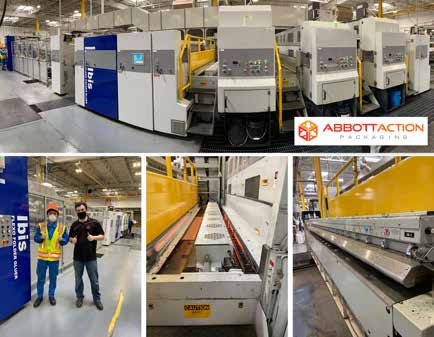
Westport, Connecticut based JB Machinery recently installed ColorDry XL3000 IR dryer systems on the 3-color Isowa Ibis Flexo Folder Gluer at Abbott-Action Packaging facility in Attleboro, Massachusetts. With over 3000 JB IR dryers installed in 56 countries on diecutters and flexo folder-gluers from all major OEMs, this marks the first JB installation on an Isowa. “It was a pleasure to celebrate this milestone event with our great friends and valued partners at Abbott-Action”, said Warren Bird, President of JB Machinery. “We congratulate Sam and his team on their installation and look forward to celebrating their success with the new capabilities ColorDry will bring to their Isowa and the added value they will create for their customers.”

JB Machinery Installs Color Dry Systems On Isowa Ibis At Abbott Action In Attleboro, MA

AICC Opens Registration For FFG Webinar

AICC, The Independent Packaging Association, has opened registration for Which Flexo Folder Gluer is Right for the Job?, a new webinar created with the support of AICC Education Investor Sun Automation, to be held Tuesday, February 2, at 2:00 p.m. EST. This webinar will help attendees evaluate the features of various flexo folder gluers to find the machine that best meets the needs of their company.

There are several quality FFG manufacturers in the market. However, not every machine offers the features that each company needs to produce the boxes in their current or aspiring order mix efficiently and economically. There are many things to consider when purchasing a flexo folder gluer. Participants will learn how to audit print jobs and process aspirations to understand the machine features they need to achieve their goals, for long runs or small orders.

This webinar will help attendees perform their due diligence and avoid costly mistakes for their company. Registration is $250 for members and $500 for non-members. This webinar is part of the All Access Pass. Pass holders can use their promo code to register at no additional cost. Register at www.AICCbox.org/Calendar. 14 January 11, 2021

NAM: Manufacturing Contributed $2.33 Trillion To U.S. Economy In Q3

The U.S. economy jumped 33.4 percent at the annual rate in the third quarter, the largest increase in the history of the series, which dates to 1947, according to Chad Moutray, Ph.D. and Chief Economist at the National Association of Manufacturers. Despite soaring in the third quarter, real GDP remained down 3.4 percent year to date. The forecast for growth in the fourth (or current) quarter is 6.0 percent, with 4.5 percent growth anticipated for 2021. Real value-added output in the manufacturing sector rose to $2.213 trillion in the third quarter, as expressed in chained 2012 dollars. It remained down 1.0 percent from the all-time high recorded in the fourth quarter of 2019 ($2.236 trillion), despite tremendous volatility year-to-date. Overall, manufacturing accounted for 11.0 percent of real GDP in the third quarter, with value-added output (in nominal terms) up to $2.329 trillion, just 1.7 percent from a record high. In the latest NAM Manufacturers’ Outlook Survey, 74.2% of respondents were either somewhat or very positive about the outlook for their company. It represented notable improvement after the 33.9 percent and 66.0 percent readings in the second and third quarters. Just over 29 percent of manufacturers said that their revenues will have recovered either before or during the fourth quarter, and 67.7 percent anticipate that their revenues will be back to pre-pandemic levels by the end of 2021. After two quarters with weaker domestic demand topping the list of primary business challenges, the inability to attract and retain talent led the pack once again in the fourth quarter.

NAM: Manufacturing Contributed $2.33 Trillion To U.S. Economy In Q3
Chad Moutray

New orders for durable goods rose 0.9 percent in November, rising for the seventh straight month. Overall, the durable goods manufacturing sector has bounced back soundly following steep declines in March and April due to the COVID-19 pandemic. On a year-over-year basis, new durable goods orders have grown by 3.8 percent since November 2019.

In last week’s releases for December, the Conference Board and the University of Michigan provided mixed news on consumer confidence. However, Americans were cautiously upbeat in their outlook, despite assessments of the economy being well below levels seen before the pandemic.

Personal consumption expenditures declined 0.4 percent in November, falling for the first time since April. The savings rate remained elevated at 12.9 percent. These data suggest that Americans were more hesitant in their consumer spending in November— something that will not be welcome news for retailers heading into the holiday season. Over the past 12 months, personal spending has fallen 1.3 percent since November 2019, largely on reduced spending for services.

Meanwhile, personal income fell 1.1 percent in November, but it has risen by 3.8 percent year-over-year. Manufacturing wages and salaries increased to $955.2 billion in November, with 3.7 percent growth over the past 12 months. The housing market continued to be a bright spot, buoyed by historically low mortgage rates. However, inventories remain very low, pushing prices higher.

CCCA’s ‘Humble Box’ Video Series Viewed Coast To Coast

According to the Canadian Corrugated & Containerboard Association (CCCA), its “Humble Box” video series has reached Canadian millennials from coast to coast.

To focus on reaching an important sector of the population with key messages about our industry, CCCA developed a series of four videos using the character of a “humble box” to tell the stories. Videos were posted on the CCCA Instagram channel and promoted to target audiences in four different sectors of the country in one-week segments. The program employed recent research that revealed how well liked we were by people that know us but highlighted that only about half the population knows us. What to do? Go tell them.

And tell them we did! Over 1.4 million impressions were achieved, but the key is that the videos were watched almost 900,000 times.

The Canadian Corrugated and Containerboard Association is a long-standing voice to embrace sustainability in all its forms and advance the competitiveness of its members across Canada. Our members do great work at reaching the trade orbit of the business. As an association, our goal is to reach beyond that realm to help in creating an understanding of the key attributes of the corrugated industry. Watch the Humble Box at www.cccabox.org.

Moving Into 2021

As we look back at 2020, I’m sure many reading this would like a mulligan: the ability to redo this year and attack some of its challenges differently. With lockdowns, an election cycle that just won’t go away, and ongoing health and economic uncertainty, it’s been an unusual year.

Moving Into 2021
Roy Oberg

Many will spend time wondering what could have been, as many of us entered 2020 with high hopes and expectations. Vacations were planned and cancelled, professional and personal goals went unfulfilled, and at the end of the day, many people will look at 2020 as a net negative. But looking back with regret is an empty exercise. 2020 is over. Whether we classify the year as “good” or “bad” just doesn’t matter, because there’s nothing we can do about it anymore. Wasting calories on this isn’t good for any of us.

George Washington once said, “We should not look back unless it is to derive useful lessons from past errors, and for the purpose of profiting by dearly bought experience.” I tend to agree with our first President here: if we must look back, let’s do so only to learn what lessons we can to make 2021 better.

On January 1, 2021, the world’s problems won’t magically be fixed. The societal, health and economic uncertainty from the virus, from elections, from general life and business, won’t just go away. However, turning the calendar does provide a chance for a mental reset. Three weeks ago, we talked about using an abundance mindset and looking for the positive in all situations, and it’s still the right mindset to move forward with.

Instead of looking back at 2020 and wondering what could have been, let’s look at what the year was. As our first President suggested, let’s look at what we can take from it. For those who had to shift to work-from-home, what “past errors” can you learn from?

For those that missed out on family or social gatherings, how have you/can you adapt to conduct those now? What useful lessons can you learn? What might you change about your gatherings once things return to “normal”?

For those that missed vacations and other chances to unwind, how can you make sure you don’t miss those opportunities moving forward? How can you create opportunities to unwind without leaving your home?

What this boils down to is making a choice: we can’t change what’s happened, but we can take positive lessons from it, and figure out the best way to push forward.

So, let’s do that, and, as always…stay strong!

Oberg Associates has been a talent acquisition and consulting resource for the corrugated packaging and paper industries since 1996. Call (972) 239-3315.

Reach a specialized audience

Advertise with BCN.

Connect with decision-makers in the corrugated and converting industry.

View Media Kit